
Physiology of the sense of smell
The sense of smell is one of the first senses that appears immediately after birth.
Despite the fact that the sense of smell accounts for only 2-5% of the information that we receive from the outside world, 3-5% of the genes in the human genome (about 1,000 genes out of a total of 20,000) relate to the sense of smell. This is a huge number; much more than the other senses, although only 350-400* of them are functional (The exact number of working genes has not been fully established yet).
*Each person has a unique set of active genes. Different people are sensitive to some odors, but ignore others. Scientists believe that these differences began to appear about 6 million years ago, when our human ancestors started to walk upright.
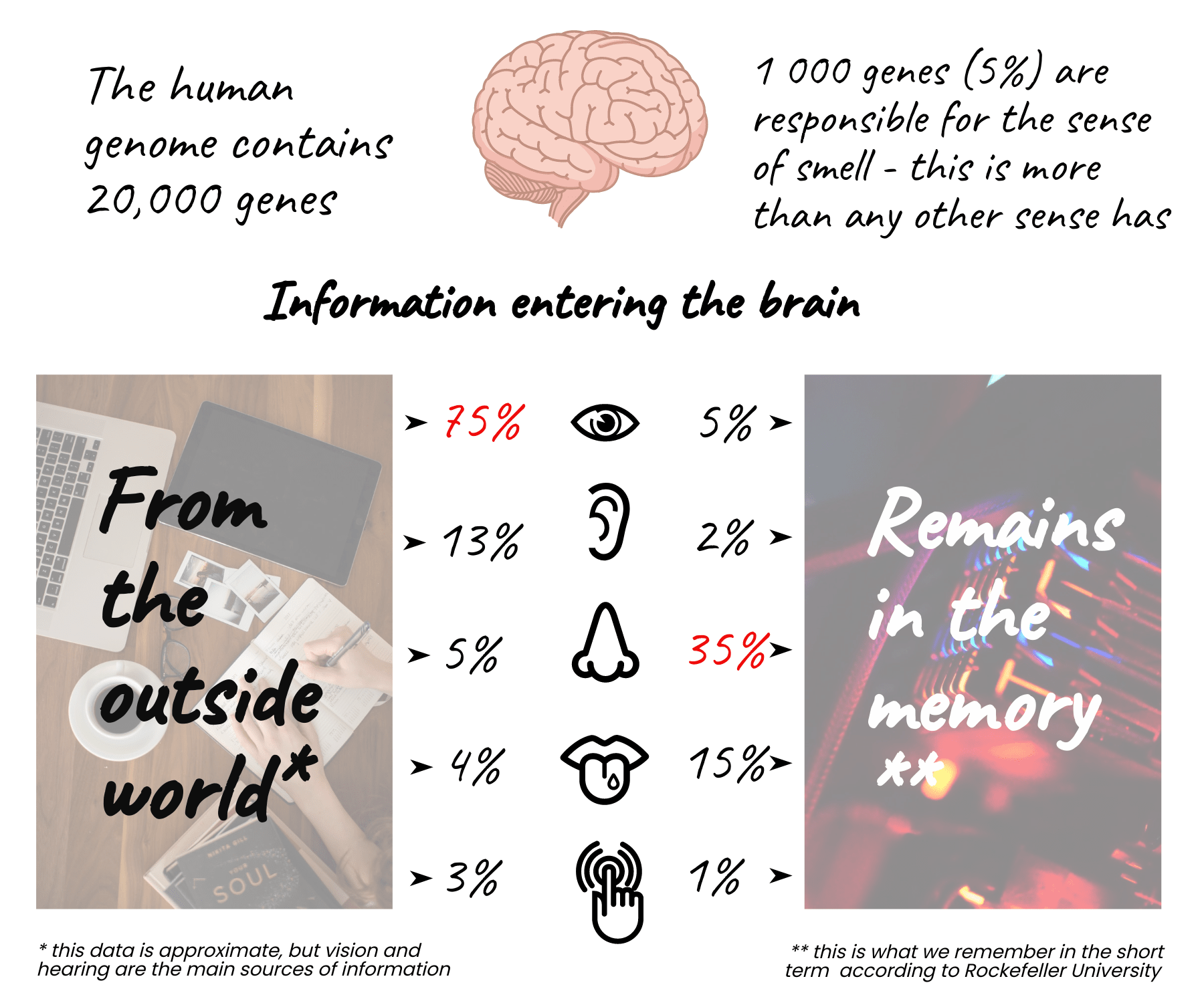
Amazing fact: olfactory receptor cells are found not only in the olfactory epithelium of the nose, but also in other organs like the brain, kidneys, prostate, mammary glands, muscles and many other parts of the body. Their function is still not fully understood though.
The main human olfactory organ
- ⚈ Location: upper part of the respiratory tract, the upper nasal Concha
- ⚈ Total area in the nasal cavities: 3-5 cm2 (1.5% of the nasal mucosa)
- ⚈ The thickness of the olfactory epithelium: 150-300 µm
- ⚈ Mucus thickness: 10-50 microns
- ⚈ Epithelial mucus renewal: 10 minutes
- ⚈ Total number of receptor cells in the nasal cavities**: from 6-10 million
- ⚈ Number of types of receptor proteins in the membrane: 350-400
- ⚈ Cell life***: 1-2 months
- ⚈ Number of distinct odors: approximately 10 thousand (possibly more)
- ⚈ Adaptation to the smell: slow - from 10 seconds to several minutes (depends on the concentration, exposure and speed of passage of air in the nose)
- ⚈ Decrease in olfactory function with age: 1% every year from the age of 25
** the exact available data varies from source to source
*** these are nerve cells that are not known to regenerate; however, the olfactory cells are directly brain cells and regenerate every
1-2 months, which makes them unique.
Olfactory Analyzer
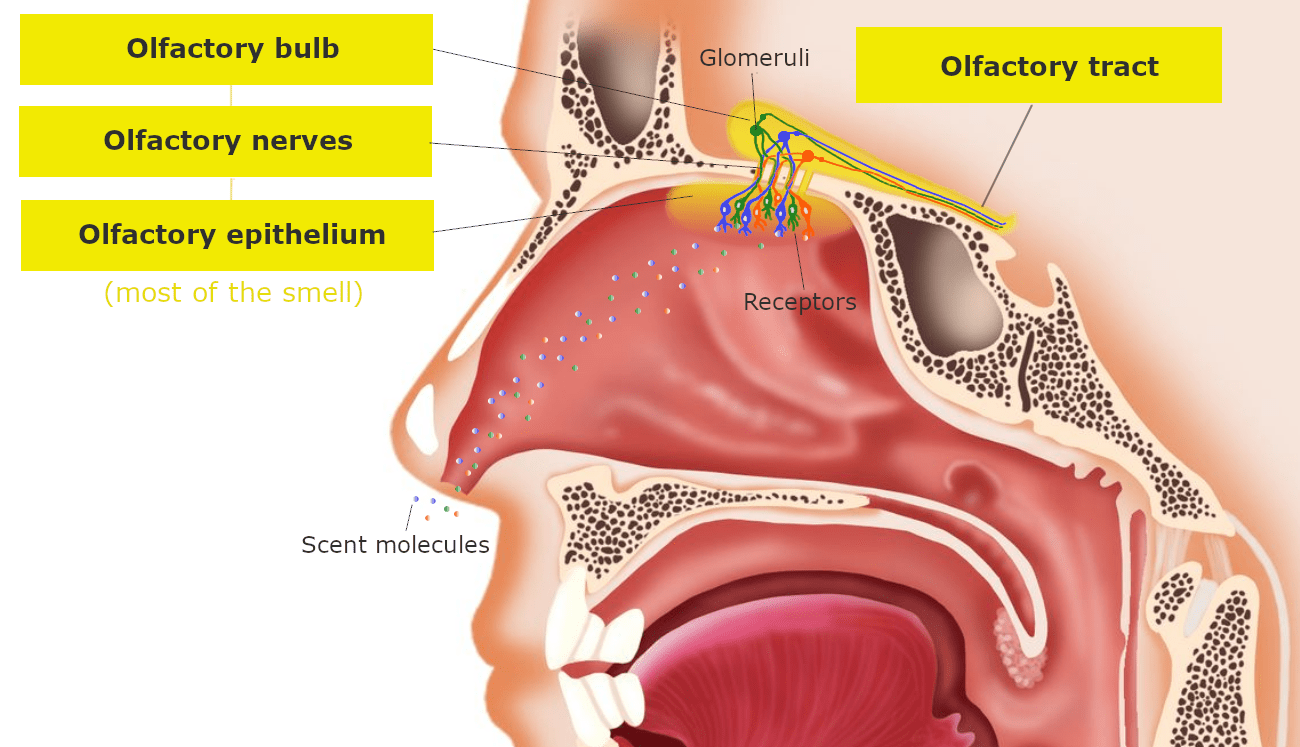
This includes the olfactory receptors and nerves, the olfactory bulb, the olfactory tract, and the olfactory centers of the brain.
The receptors/neurons/cells of the olfactory epithelium contain movable cilia that capture odor molecules and hold them in the mucous membrane, and then transmit a nerve impulse via olfactory nerves to the bulb.
The olfactory bulb is a small organ. This is a part of the brain limbic system. The bulb contains glomeruli and the mitral cells that analyze the signal received from the receptors. The signals go to the brain through the olfactory tract.
The sense of smell is very closely related to the work of the limbic system of the brain. This is the ancient part of the brain that is responsible for memory, emotions and behaviour. Some scientists think of the limbic system as the central part of the brain that “emotionally” makes decisions before we realize it.
This is also one of the reasons why we react to smells almost instantly. The signal goes directly to the hippocampus, which is responsible for associative memory, and to the amygdala, where memories are processed and memory associated with emotions is formed. From there, the signal goes to the thalamus, which determines the level of our consciousness and concentration of attention.
These centers of the brain connect the olfactory system with other sensory systems, which ultimately form the overall impression of the smell and can provoke different behaviors.
It should be noted that, in the process of evolution, the sense of smell appeared before other senses (also smell is the first thing we feel at the moment of birth) and it is directly connected with different parts of the brain.
How does the main olfactory organ work?
The receptors of the olfactory epithelium, with the help of cilia, capture a few molecules of the odorous substance. About one to eight molecules are enough to excite the olfactory cells. It converts chemical stimulation into a nerve impulse (electrical signal), which enters the olfactory bulb via the nerves. The olfactory bulb contains about 2000 glomeruli (synaptic contacts) for processing the primary signal and further transmission to other parts of the brain.
Different olfactory cells seem to contain a specific type/form of protein that allows them to respond to individual odors.
What are smells?
There are several theories of distinguishing odors, and one of the most famous is the stereochemical theory of odor created by Dr. Eimer. According to this theory, the molecule of the odorous substance must correspond to the shape (well-depressions) of the receptor proteins in the olfactory epithelium - like the key to a lock. As soon as there is a match, a signal about a certain smell is transmitted to the brain.
In 1999, scientists Linda Buck and Bettina Malnic from Harvard Medical School made a revolutionary discovery and was awarded the Nobel Prize. The brain distinguishes smell, not so much due to one type of receptor for each individual smell, but rather a combination of different receptors that respond to the components of the smell. One receptor can respond to different aroma, and one aroma can be recognized by many receptors, thus creating a "receptor alphabet".
It is also worth noting here that our perception of smell is complex: we perceive the fragrance as a whole thing, without breaking it down into separate parts. For example, if we take the substance of 1.5-octadien-3-one, which smells of geraniums and mix it with methional which has the smell of fried potatoes, in a ratio of one to one hundred, we get the smell of fish! (Bob Holmes, "Taste. The Science of Our Most Neglected Sense”).
Other olfactory organs
The Masera’s Organ
So, the molecules of odorous substances enter the nasal mucosa through the nasal or oral cavities. But even here, everything is not so clear. It is believed that the olfactory epithelium, located far from the nasal entrance, senses no more than 7-10% of the air flow. And as a rule, normally we do not consciously smell anything.
In the 19th century, scientists carried out some quite unusual experiments on catching odors. For example, they once cut the head of a deceased person in half and placed pieces of pink litmus paper in the nasal cavity. Then the halves of the head were placed back together and ammonia vapor was pumped through the nostrils. It then turned out that the litmus paper located in the zone of the olfactory epithelium did not change color to blue under the influence of ammonia. This meant that the air carrying the smell barely reached the zone of the olfactory receptors.
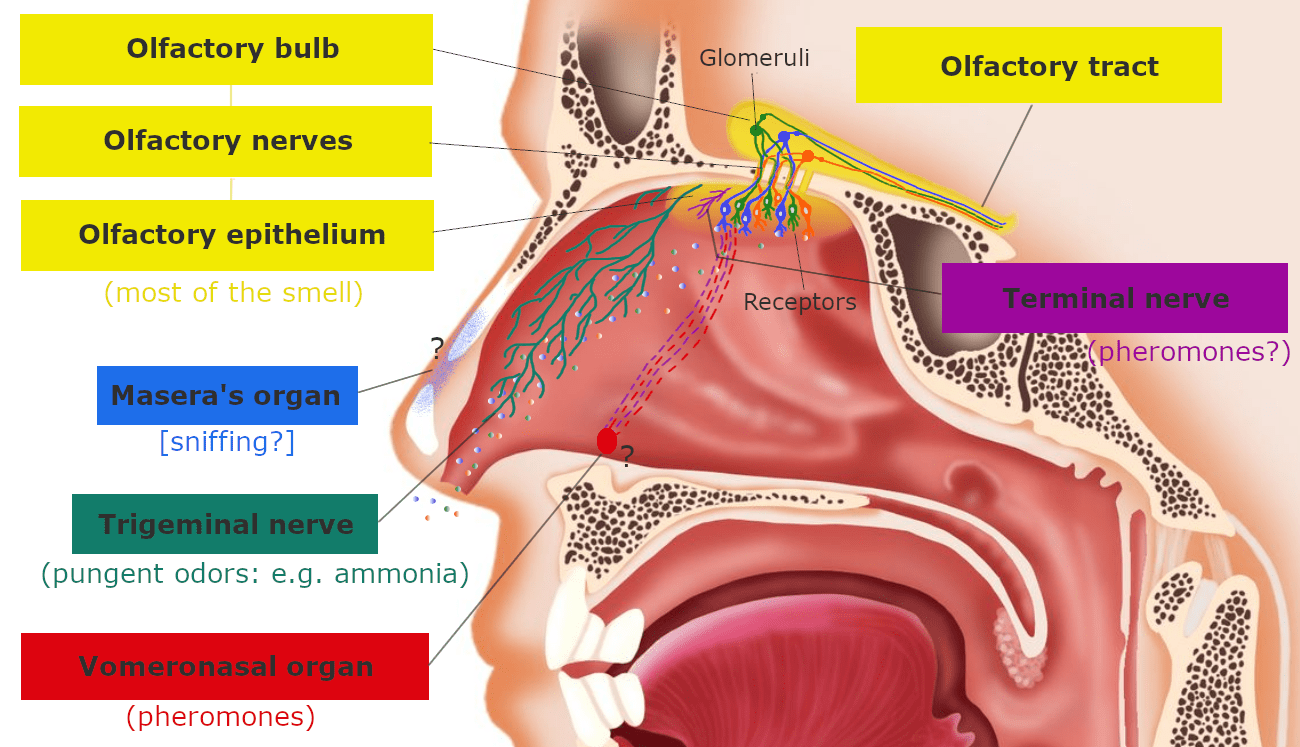
In order for this to happen, our nose needs to sniff the smell (in this case the muscles work differently and direct the airflow in a different way). But what makes us sniff is still an open question. Scientists suggest that this might be a Masera organ: this is a bump in the area of the nasal septum which catches the slightest aroma. It was discovered by the Italian scientist Rodolfo Masera in animals in 1943 and has not been studied much so far. Also, it is not confirmed whether an adult human has it.
Vomeronasal organ (pheromones)
This organ captures pheromones; chemicals that act similarly to hormones which regulate the internal processes of the body. Conversely however, pheromones are produced and emitted for “communication” and interaction with other members of the species.
At the moment, pheromones are found in insects, reptiles, and some mammals. But it is still unknown whether humans have them. Nevertheless, the vomeronasal organ is definitely present in embryos. Children, and presumably about a third of adults, also have it (it’s believed that this organ is reduced with age). Another name for this organ is Jacobson’s organ. It’s also known as an additional organ of smell.
The vomeronasal organ consists of two small tubes at the base of the nasal septum that open into the mouth (in snakes, wolves, deer) or nose (in mice, humans). In animals, the receptor part, which exclusively captures pheromone molecules, transmits a signal along a separate nerve to a separate olfactory bulb, which is different from the bulb of the main olfactory organ. The signal from this bulb goes directly to the brain, particularly to the hypothalamus.
Modern research confirms that in humans, this organ is most likely a "vestige”: it does not have a separate olfactory bulb and there is no part of the brain that picks up its signals. The genes encoding it are mostly pseudogenes (only 5 functional ones are known). However, its role has yet to be established by scientists.
Most likely, you have heard about the most famous human pheromones: androstadienone and estratetraenol, but it has not yet been proven that they have a sexually arousing effect on humans. Perfumes with pheromones are still produced by some companies however, including the “pheromone” pioneer Erox).
Trigeminal nerve
This is the largest cranial nerve. It gets its name due to the fact that it has three sub-branches (the orbital, maxillary and mandibular nerves). We are always aware of the trigeminal nerve when we inhale “sharp” odors such as ammonia or camphor. At the same time, the body receives a clear signal to move away from the source of the smell.
Terminal nerve
The terminal or null nerve was only discovered in the human skull in 1913 and its function is still unknown. It is closely adjacent to the olfactory nerves, and may be involved in the process of pheromone perception by the vomeronasal organ. It is possible that it can perceive pheromones by itself.
The organs with the olfactory receptors
It might sound strange, but some human organs have olfactory receptors.
In 2019, the journal Chemical Senses published the results of a study made by American scientists who found olfactory receptors on the tongue: it means they can change the sensation of taste in the mouth. How is the signal from these cells processed? It has not yet been established, but this discovery has practical applications: when food is exposed to the olfactory receptors, it can taste sweeter with a minimum amount of sugar, which will help reduce the amount of sugar consumed.
Earlier, the molecular biologist Hans Hutt determined that sperm have olfactory receptors that help them find the egg by following the scent. According to the results of the study, the smell of an egg is similar to the scent of a lily of the valley when it is ready for fertilization!
He also found that 15 receptors of the olfactory epithelium are also found in the skin, which responds well to the synthetic fragrance of sandalwood "Sandalore." According to experiments, scratches on the skin healed around %30 faster when this fragrance was sprayed into the air.
According to research by biologist Grace Pavlat, the effect of rapid recovery was also found in skeletal muscles that respond positively to the lyral molecule, which has the aroma of lily of the valley, cyclamen and lilac.
See also:
Olfactory disorders | Odors and Covid-19 | Parosmia